
*This is a plain text version of our newsletter. For more images, please download the PDF.
Pam Kisch, who founded the Fair Housing Center in 1992, retired after more than 33 years with the organization.
Pam was a force in the fight for fair housing. She dedicated her career to ending housing discrimination, and her work impacted hundreds of thousands of Michiganders.
As Executive Director, Pam not only kept the day-to-day operations of the FHC running smoothly, but also put her boots on the ground to advocate for individuals and families.
Under Pam’s leadership, the FHC aided in the filing of over 100 lawsuits, with total settlements for complainants exceeding $3.5 million. Her work helped ensure that residents of Southeast and Mid Michigan were not illegally denied housing because of their race or subjected to policies that made it more difficult for people of color to access the same opportunities as white community members. Each lawsuit, each policy change, each successful request for reasonable accommodation for a person with a disability—these actions not only impacted individual complainants, but also had a ripple effect to create new, equitable housing opportunities for our communities’ most disenfranchised residents.
In fall 2025, the FHC Board of Directors appointed Kristen Cuhran as the organization’s second-ever Executive Director. Kristen joined the staff full-time in 2006 and has held every program position. Kristen recently spoke to WEMU’s David Fair; you can listen at tinyurl.com/KristenOnWEMU.
Pam—from all of us at the FHC: thank you for everything you have done to build a more equitable and inclusive Michigan. We know we’re in good hands, and that’s a testament to the foundation you built. Your commitment, leadership, and expertise helped bend Michigan’s housing landscape toward a more equitable future. We miss you, wish you all the best in your next adventure, and promise to do our best to uphold your legacy through the years to come.
The FHC is a membership organization and relies on financial contributions from community members like you to keep our operations running smoothly. If you’d like to make a contribution in honor of Pam’s legacy, please consider making a donation today at fhcmichigan.org/donate. Thank you!
Disclaimer: It is understood that in all cases reported in this newsletter, the defendant, unless noted otherwise, denies the allegations of discrimination made by the plaintiff and, in “settled” cases, the parties have agreed to resolve the case prior to a trial on the merits.
Emotional Support Animals
A Shiawassee County man and his fiancée wanted to live together. Carter* was just a few months into his lease agreement at an apartment complex in Owosso when he attempted to add Jenny* to his lease. But Jenny’s application was denied—because she had an emotional support animal (ESA).
Carter had already been living with his own ESA, which the apartment complex said they would not permit because they were a “no pets” property. Eventually, they relented, telling Carter he could keep his own animal, but that they would not renew his lease and certainly wouldn’t add a new household member with their own ESA.
The apartment complex acted as though their “no pets” policy superseded the Federal Fair Housing Act, but no housing provider can implement a policy that unlawfully discriminates against residents or prospective tenants because of their mental/emotional disability.
Our testing revealed that the apartment manager told prospective renters that they would not accept assistance animals of any kind.
Carter and Jenny chose to work with FHC Cooperating Attorney Francyne Stacey to file a lawsuit in Federal Court. They may have lost their preferred housing, but their case settled for an undisclosed amount.
Carter and Jenny knew the law was on their side, and speaking up helped send a message to Shiawassee County and beyond—housing providers cannot use “no pets” policies to circumvent the law. Their story will open up housing opportunities for other mid-Michigan residents with ESAs.
Court: Federal
Settlement: Non-Disclosed
Landmark Source of Income Case
Megan Morse dreamed of returning to Ann Arbor, the city where she was born, to be close to her daughter and the University of Michigan Hospital, where she participates in epilepsy studies. Living with epilepsy and other disabilities, she relies on Social Security and a housing voucher to pay rent. When she applied for apartments managed by Wilson White Company, she was told that they did not accept tenants who use housing vouchers.
Our testing confirmed that Wilson White had refused to rent to people using vouchers, in violation of Ann Arbor’s Non-Discrimination Ordinance, which bans source of income discrimination. With FHC support, the Civil Rights Litigation Initiative (CRLI) at the University of Michigan Law School filed suit in Washtenaw County Circuit Court in 2023.
The court approved a settlement in April 2025 requiring Wilson White to accept vouchers, train its staff, and update its rental materials.
Megan’s courage led to the first successful lawsuit under Ann Arbor’s source of income ordinance since it was revised to specifically include Housing Choice Vouchers, a landmark victory that expanded fair housing rights for residents who rely on housing vouchers.
Court: Circuit
Settlement: Non-Disclosed
Children of Different Sexes Can Share a Bedroom
Aaron Taylor and his fiancée were building a new home and needed a place to live while construction was underway. They thought they had found it at Willows on Twin Ponds in Jackson until the property manager told them their children, a boy and a girl, could not share a bedroom.
The family contacted the Fair Housing Center, and our testing mirrored their experience. At their request, FHC staff reached out to the manager to explain that prohibiting siblings of different genders from sharing a room would violate the Fair Housing Act. The manager asked that Aaron return the next morning, promising to work with him.
But when he arrived, she again refused to rent to the family.
With FHC support, Cooperating Attorney Francyne Stacey filed suit in the U.S. Federal District Court for the Eastern District of Michigan on April 29, 2022. The case was assigned to the Honorable Linda V. Parker and later settled for an undisclosed amount.
Aaron’s persistence helped affirm that families have the right to choose how they live together without fear of discrimination.
Court: Federal
Settlement: Non-Disclosed
Disability and Aging in Place
For more than 40 years, William and Margaret Galligan called their Miller Maple Townhome in Ann Arbor home. When Mr. Galligan, 83, was diagnosed with terminal cancer and dementia, his daughter, Krista Lichterman, requested a month-to-month lease on his behalf so he could remain in hospice care at home. The property manager denied the request, even after receiving a letter from Mr. Galligan’s doctor warning that a move could endanger his life.
Desperate, Krista turned to the Fair Housing Center for help. FHC staff contacted the property’s management company and formally requested a reasonable accommodation, explaining that under fair housing law, landlords must adjust their rules to meet the needs of tenants with disabilities unless doing so is unreasonable.
When the company refused to cooperate, the FHC connected the Galligans with a cooperating attorney who filed suit in Washtenaw County Circuit Court in August 2025. The action prevented an eviction, and the family was permitted to remain in their home on a month-to-month lease.
The Galligans’ case ensured that Mr. Galligan could spend his final days in peace, surrounded by family and the home he loved.
Court: State
Settlement: Non-Monetary
Failure to Grant Reasonable Accommodation
When Carol Walton moved into Somerset Park Apartments, she provided a list of accommodations she needed to live safely: grab bars, an accessible parking space, and full access to common areas. The agent assured her these updates would be made.
They never were. In the summer of 2024, Carol fell in her bathroom and was injured. To make matters worse, around the one-year mark of her tenancy, she received a demand for possession from the property manager.
In early 2025, Carol contacted the Fair Housing Center for help with her self-filed federal case. After reviewing the details, we connected her with Cooperating Attorney Francyne Stacey, who took over representation.
The case, heard in the Western District of Michigan, was resolved in August 2025 for an undisclosed amount.
Carol’s story is a reminder that accessibility is not optional. Her determination turned an unsafe situation into lasting accountability.
Court: Federal
Settlement: Non-Disclosed
Disability Income, Reasonable Accommodation
When Jerri Dombrowski was denied the opportunity to rent from Royal Glen Apartments solely because she did not meet its “three times the rent” requirement, she was furious. Living with a disability, Social Security Disability Insurance (SSDI) made up about half her income, and the other half came from part-time employment, so she could never reach the rent threshold. In response, she requested reasonable accommodation, asking that Royal Glen make an exception to its policy and allow her to rent with her income of two times the rent. Royal Glen denied her request.
That’s when Jerri decided to take matters into her own hands and file a pro se lawsuit (without the aid of an attorney) against Royal Glen. Once the case was in discovery, she also reached out to the FHC for additional assistance. After reviewing the facts, we connected her with FHC Cooperating Attorney Francyne Stacey, who represented Jerri through the rest of the case. The case, which settled for an undisclosed amount, sends the message that when it comes to issues of disability and renting, housing providers need to make reasonable exceptions to their rules to ensure people with disabilities equitable access to housing.
Court: Federal
Settlement: Non-Disclosed
Refusal to Provide Accessible Parking Space
Spring Hill, a renter with a mobility disability, contacted the FHC when her landlord refused to grant her an assigned accessible parking space. Living at a Provident Asset Management property, she was often unable to access the sidewalk safely with her walker due to other residents’ vehicles blocking her path. When Spring made her first request for reasonable accommodation to the landlord, she was told it would be unfair to other residents if she were granted a designated parking space since all residents were provided parking under their lease agreement.
FHC staff stepped in to explain the protections afforded to renters with disabilities like Spring’s under the Federal Fair Housing Act (FHA), making it clear that the FHA preempted any protections under state contract law that governed the lease agreement with other tenants. The landlord continued to deny the request for reasonable accommodation, so Spring chose to work with Cooperating Attorney Francyne Stacey to sue the housing provider in the Eastern District of Michigan. Assigned to the Honorable Judith Levy, the case settled for an undisclosed amount in May 2026.
Court: Federal
Settlement: Non-Disclosed
Michigan’s First Source of Income Case Under ELCRA
With a Housing Choice Voucher in hand, Ebony Birton applied to live at South Grove Apartments in January 2026. However, South Grove reportedly told Ebony that they would not accept the voucher through RPI Management because the housing provider does not enter into third-party contracts. South Grove went as far as to suggest that Ebony transfer her voucher to another service provider, which a tenant can only do under very specific circumstances.
South Grove approved Ebony’s rental application but refused to accept her voucher. With nowhere else to go, she signed the lease, moved in, and contacted the FHC.
FHC phone testing confirmed that South Grove Apartments would only accept vouchers from the local housing commission and not through other voucher administrators such as RPI Management, stating that they do not enter into contracts with third parties. This policy violates the new Source of Income protections under the Elliott-Larsen Civil Rights Act. Under this law, any landlord with more than five rental units must accept Housing Choice Vouchers, which includes signing a HUD-mandated (third-party) HAP contract. A landlord also cannot pick and choose which MSHDA HCV providers to work with.
Ebony filed a Circuit Court complaint against South Grove Apartments with the assistance of FHC Cooperating Attorney Robin Wagner in March 2026. The case filing was the first brought under the new Source of Income protections under ELCRA, added to the statute in April 2025.
Ebony won her motion for preliminary injunction on April 29, 2026, when Washtenaw County Circuit Court Judge Julia Owdziej ordered South Grove Apartments to accept Ebony’s HCV and to sign the mandatory HAP contract. The suit will continue to the discovery phase of the case.
Failure to Repair Exacerbates Disability Symptoms
Melissa Martin told her landlord that the defective HVAC system in her rental unit was exacerbating the symptoms of her physical disabilities. She requested that repairs be made as reasonable accommodation of her disability, but instead of granting the request, the landlord retaliated by not renewing her lease.
By the time Melissa contacted the FHC, she had been navigating Circuit Court on her own, having filed a pro per complaint (without legal representation) in September 2025. FHC staff reviewed the facts of the case and determined that because Melissa had not specifically pleaded a violation of the Fair Housing Act, we could support her in pursuing a federal disability discrimination case. Melissa ultimately chose to work with FHC Cooperating Attorney Francyne Stacey, who filed the case in the Eastern District of Michigan against the management company, Venture Properties LLC, and the owner, Novelty Brands LLC. The case is assigned to the Honorable Judith Levy.
Woman Suffers When Caregiver Banned from Property
Maria Lawson was the first tenant to move into Melvin T. Walls Manor when the property opened in 2004. Despite living with significant physical disabilities, she was able to stay in her home for over 20 years, thanks in part to the support of her fiancé, Andrew*, who also served as her primary caregiver. While the couple didn’t live in the same unit, they both resided at the same apartment complex.
That was—until Melvin T. Walls tried to evict Andrew.
Andrew had a felony conviction for which he served over 40 years in prison. Despite this obstacle, he was approved to live at Melvin T. Walls in 2023. Yet in 2025, after recently recertifying his lease for another year, the property manager began threatening to evict him, in part because of his criminal record. He ultimately obtained a Housing Choice Voucher and moved elsewhere, intending to visit Maria daily to continue his caregiving duties.
When Melvin T. Walls issued a “no trespassing” order against Andrew, the FHC stepped in. Andrew posed no risk to residents, and Maria was suffering without Andrew, having essentially lost her caregiver and closest companion. FHC staff wrote a request for reasonable accommodation, asking that Andrew be permitted on the property to serve as Maria’s primary caregiver, but the manager denied it. After subsequent advocacy efforts, accompanied by supporting medical documentation, were also denied, Maria chose to work with FHC Cooperating Attorney Chanelle Manus to file a federal disability discrimination lawsuit in the Eastern District of Michigan on March 5, 2026. The case is assigned to the Honorable Terrence Berg.
The FHC resolves many reasonable accommodation and modification requests each year. The cases described below are just a few examples of the successful resolutions we’ve reached over the past 18 months.
Gloria*, a local woman with a physical disability, warned her condo board that their planned renovations could make the building inaccessible. She even asked to join the design committee—but was denied. The board went ahead and installed carpet padding, making it nearly impossible for her to navigate her own building in a wheelchair. When Gloria’s concerns were dismissed again, she contacted the Fair Housing Center.
We immediately brought in an architect who specializes in accessibility, who confirmed the issue: the carpet padding was too soft to meet accessibility standards. FHC staff wrote to the condo association’s lawyer, requesting that the padding be replaced as a reasonable modification under fair housing law. After months of negotiations involving the condo board, their architecture firm, and our team, they finally agreed to replace the padding.
The new, accessible carpet is now in place throughout all buildings and commons areas in the community.
Janine*, a single mom, faced eviction from her subsidized unit after her son—who has severe autism and other mental disabilities—picked at the drywall, a behavior common among children with his condition. But instead of working with the family, the landlord began eviction proceedings.
Unfortunately, this was not the first time Janine had to fight for her son’s rights. She had already faced three separate battles for reasonable modifications with this same landlord. Each time, they either denied the request or delayed it until the Fair Housing Center stepped in.
In this latest case, FHC staff stepped in again. They met with the landlord’s attorney, documented the discrimination, and formally requested the landlord install protective wall padding—a simple change that would prevent future damage and allow Janine’s son to remain safely at home.
The result: the landlord dropped the eviction and made the modification.
Georgia*, a local senior with a physical disability, struggled for nearly a year to get her landlord to approve a chair lift in her townhome. She needed the lift to access her second floor, but despite repeated requests, she was met with delays and excuses.
When she reached out to the Fair Housing Center, our staff pushed the landlord to respond. A contractor came to take measurements but claimed the installation wasn’t possible due to a narrow staircase. Georgia knew something wasn’t right.
The FHC brought in an architect who specializes in accessibility. He visited the property and found that the staircase was in face wide enough for a chair lift—the kind that allows someone to sit and ride up the stairs. He suspected the landlord’s contractor had been measuring for a wheelchair lift, which requires much more space.
With this clarity, FHC staff worked with the landlord to get the correct installation moving. Georgia know has a working chair lift and a new railing to support her mobility needs.
Bill* was living in an apartment with constant, disruptive noise from his upstairs neighbors for nearly a year. The stress and sleepless nights began taking a toll on both his physical and emotional health. As a person with disabilities, the lack of quiet became not just an inconvenience but a serious threat to his wellbeing.
Despite his repeated complaints, the landlord did nothing to resolve the problem. That’s when Bill contacted the Fair Housing Center.
FHC staff submitted a reasonable accommodation request to Bill’s landlord, asking that he be allowed to break his lease early without financial penalty. The request was approved. But the support didn’t stop there—FHC also helped Bill navigate issues with his new landlord to ensure a smooth transition into his next unit.
Over the past year, the FHC has added two new staff members and hosted an MSW intern, and two new members were elected to our Board of Directors. We’re pleased to introduce you to:
With over 20 years of case management and advocacy experience, Timzetta Dickson, MSW, joined the FHC in March 2026 as our first Advocacy Specialist. She now supports complainants in need of support with gaining reasonable accommodations and modifications in their housing.
FHC’s newest Assistant Coordinator of Investigations, Cherissa Stitt, joined the FHC in September 2025. Cherissa is a long-time Washtenaw County resident with an extensive background in the fields of science and mathematics, and she’s bringing her analytical skills to the FHC. Cherissa is the FHC’s primary test coordinator, working with our enforcement team to investigate and uncover discriminatory housing practices in our communities.
Longtime FHC supporter Eleanor Chang was elected to the FHC Board of Directors in December 2025. As a licenses social worker at Disability Network Washtenaw Monroe Livingston, Eleanor is well acquainted with barriers facing persons with disabilities-especially persons who need accommodations but who may not know their rights, or who are intimidated and therefore shy away from voicing their requests.
Eleanor believes firmly that stable, affordable housing which is *safe* (whatever our individual identities, and whatever our individual needs regarding accommodations) is a key component to our growth as humans. She first referred a case to Fair Housing Center of Southeast and Mid Michigan in 2014, and intends to continue to seek housing justice as a member of the Board.
DJ Grubaugh is celebrating her 12th year as a Peckham employee, where she has worked alongside the Capital Area Michigan Works (CAMW!) team delivering workforce development programming to the metro-Lansing region. As the Director of Community Services, DJ provides oversight and support to her team’s workforce preparation programs for low-income individuals and families. As a lifelong Lanstranaut, DJ graduated from Michigan State University’s James Madison College with a Bachelor’s degree in Social Relations & Policy. She now embraces life with her partner and their toddler, traversing the National Parks and the natural beauty that Michigan has to offer. Another longtime FHC supporter, DJ was elected to the Board of Directors in December 2025 and is the organization’s first board member from mid-Michigan.
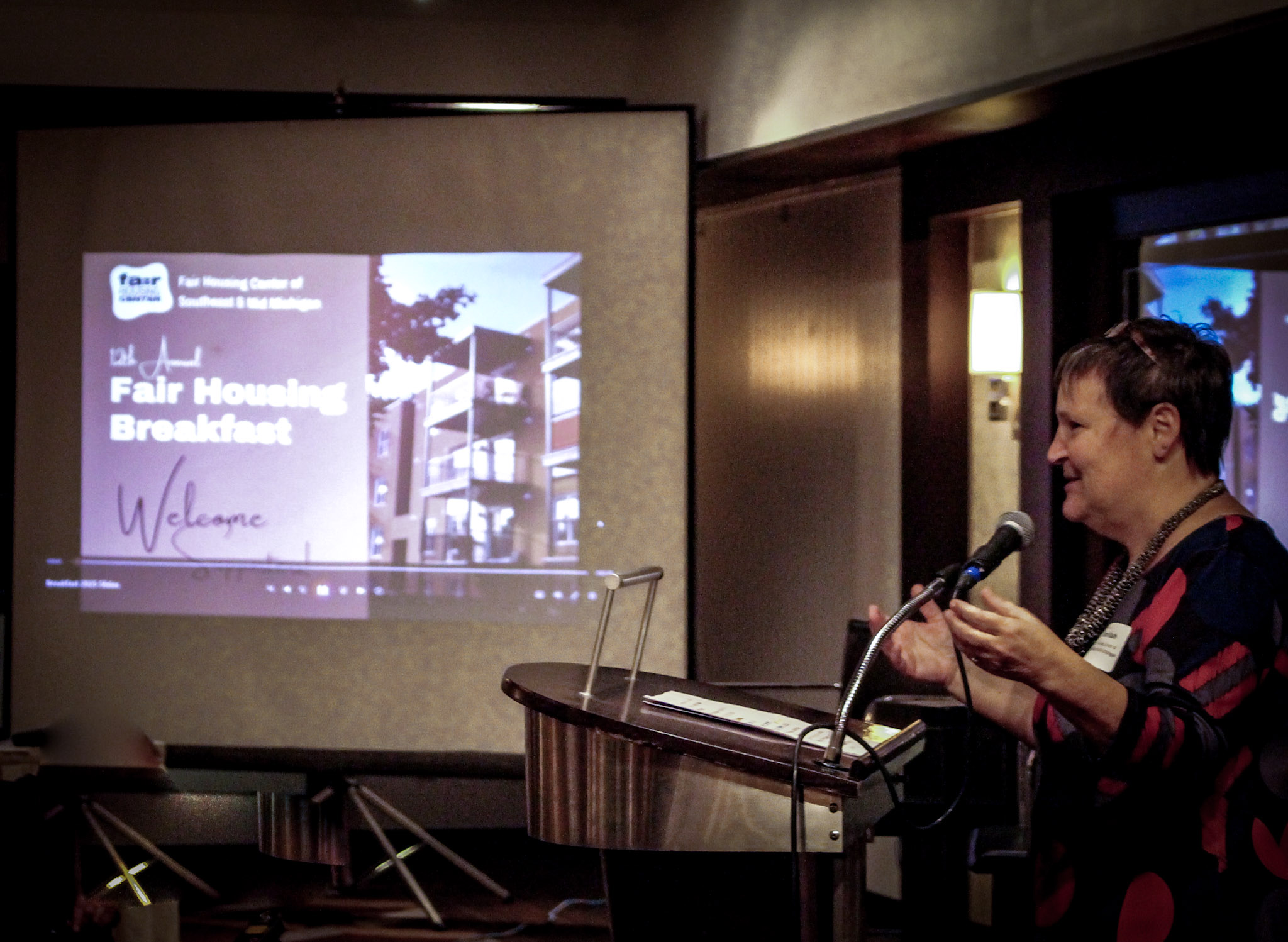
Michelle Adams, author of The Containment, was joined in conversation with Lester Graham at our 12th Annual Fair Housing Breakfast in October 2025. One of our most successful fundraisers to date, we raised over $51,000 for civil rights education and enforcement.
Thank you to our generous sponsors:
Silver Sponsors: Fifth Third, Washtenaw County Office of Community and Economic Development, Zingerman’s Community of Businesses
Bronze Sponsors: Bank of Ann Arbor, Delta Dental, FHLBank Indianapolis, Greater Metropolitan Association of Realtors, Lake Michigan Credit Union, Michigan Realtors, Old National Bank, Parda Credit Union, Reinhart Realtors, University Bank, Zillow
Individual Sponsors: First Merchants Bank, Michigan State Housing Development Authority
The Fair Housing Center, along with the Ann Arbor District Library, welcomed Macarthur Cotton and John Obee to discuss their new book, Mississippi’s Black Cotton. The event provided a unique look into Cotton’s youth and adolescence growing up in the South, as well as his activism against white supremacy in the 1960s. You can view the recording at aadl.org.
After a successful Fair Housing Month fundraiser in April 2026, FHC staff, board members, and supporters gathered at the Ypsi Cocktail Club to celebrate our 3rd annual Fair Housing Mixer. Sponsored by Lake Michigan Credit Union, the event featured craft cocktails and mocktails, charcuterie, and conversation.
FHC staff members Niki Green and Jessica Farely, along with Managing Attorney Michael Derby from Legal Services of South Central Michigan and Housing Attorney Jim Schaafsma from Michigan Poverty Law Program, presented Housing Advocates Training (HAT) in Jackson in May 2026. This training, designed to provide social service professionals with a working knowledge of fair housing laws, landlord-tenant laws, and housing subsidy programs, remains our most requested training.
Featuring Guest Speaker Laura Arce from UnidosUS, the breakfast will be held on Thursday, October 15, 2026. One Fair Housing CE credit is available for Realtors. Tickets will go on sale later this summer. For sponsorship inquiries, please contact Kristen Cuhran, Exectutive Director, at kcuhran@fhcmichigan.org.
The fall session is tentatively set to take place in Monroe this September. Be on the lookout for registration information in July.
The FHC is always recruiting qualified individuals of all ages (18+), races, genders, and abilities to serve as Testers. Testing is a unique, flexible opportunity to contribute to FHC’s efforts to uncover illegal housing discrimination throughout Southeast and Mid-Michigan. For more information, visit fhcmichigan.org/tester or contact Cherissa Stitt, Assistant Coordinator of Investigations, a cstitt@fhcmichigan.org.
The FHC invites you to join us for a one-day training in October on fair housing litigation for current and future FHC cooperating attorneys, presented by national expert attorney Steve Tomkowiak. Location and Date TBD. Reach out to Niki Green, Director of Enforcement, at ngreen@fhhmichigan.org for more information.